Business Finance | Warren Buffett | Should We Depreciate Our People?

A Weekly Business Finance series for Non-Finance Executives!
“Financial Adrenaline” is a term we love around here because it reflects our commitment to help you turbocharge your business with practical tips and techniques to improve free cash flow, the lifeblood of business. As a further extension of our Financial Adrenaline program, we’re going to share a new Business Finance Tidbit every Wednesday specifically for those business executives who don’t have a finance background.

____________________________________________

Depreciation = Cash? Why do we care?

We’ve kinda been on a Warren Buffett tear lately, and last week I encouraged you to read his recent 2010 Annual Report to Berkshire Hathaway shareholders.

I want to plant another seed this week about an often misunderstood concept: [kastooltip msg=”DEPRECIATION” tooltip=”In accounting, an expense recorded to allocate a tangible asset’s cost over its useful life. Because depreciation is a non-cash expense, it increases free cash flow while decreasing reported earning. It is used in accounting to try to match the expense of an asset to the income that the asset helps the company earn. For example, if a company buys a piece of equipment for $1 million and expects it to have a useful life of 10 years, it will be depreciated over 10 years. Every accounting year, the company will expense $100,000 (assuming straight-line depreciation), which will be matched with the money that the equipment helps to make each year.”]. (You can see the definition by placing your cursor over the term.)

How is Depreciation Relevant to EBITDA?

Today, let’s just think about it in terms of EBITDA. In Does EBITDA Bury Its Own Dead?, I wrote about the perils of treating EBITDA as a placeholder for cash flow, and Buffett couldn’t agree more.

In his Annual Letter to Shareholders, 2002, Buffet describes (more…)
Continue ReadingBusiness Finance | Warren Buffett | Should We Depreciate Our People?

Business Finance | Why you should read Warren Buffett’s Letter

A Weekly Business Finance series for Non-Finance Executives!

____________________________________________

Read Warren Buffett’s Letter to Berkshire Hathaway Shareholders

So, why not  jump into the deep end right now by reading Business Finance is about much more than finance

I’ve said before that leaders don’t have the luxury of confining their interests to just a few things

(more…)

Continue ReadingBusiness Finance | Why you should read Warren Buffett’s Letter

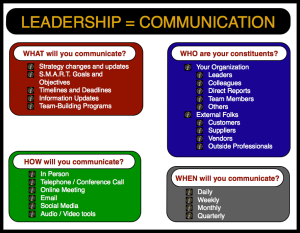
Does Leadership = Communication? | Use this Communication Matrix

Funny goofy guy with a bull hornYou need Leadership Skills to ascend to the C-Suite

A young friend of mine called me recently and said he was being considered for the CEO position of his young but growing company

He was elated, so excited, so thrilled to be considered until the “be careful what you wish for” axiom popped into his head and he realized he was pretty inexperienced in leading an organization of any size

We went on to talk about his concerns and as he began to think about his candidacy, it dawned on him that he had a very limited finance background … he didn’t think much about communication … and could be a better team player. (more…)

Continue ReadingDoes Leadership = Communication? | Use this Communication Matrix

Nothing But LEADERSHIP | Practical Tips to be a Great Leader

What Does It Take to be a Great Leader?

What do you think we’d get if we asked everyone who writes about Leadership to offer up a definition?

Probably need a new wing in the Library of Congress, don’t you think?

For some, it’s everything and anything that has to do with influencing others. It’s communication. It’s achieving accountability. For others, it’s a body of work built around values and character and timeless qualities of integrity, passion, respect, et. al. Do you have a definition that works for you?

Leadership Lessons don’t march in a neat formation

As we’ve all learned, most of life’s lessons don’t travel in a neat formation accompanied by bugles and cavalry. They arrive filthy and unkempt, prominent in the mess we’ve made around our foxhole. These lessons are typically the offspring of hubris … naivete … and ignorance … or simply from overlooking the land mines hidden beneath our feet.

This series is ONLY about practical strategies to help you become a better leader

This series is not about reiterating or re-examining the principles of leadership that so many seasoned professionals have so eloquently described. Leadership observers have extracted lessons from Julius Caesar to Patton, Jesus to Mohamed and (more…)

Continue ReadingNothing But LEADERSHIP | Practical Tips to be a Great Leader

Leadership Styles: The Smartest Guys in the Room can kill you!

When a fellow says it hain’t the money but the principle o’ the thing, it’s th’ money.” — Frank McKinney

‘Always ask why.  Dig deeper.  Get the facts.’ Avoid the crowd mentality

“Ask Why” was their motto.

“Wheel Out,” “Fat Boy” “Death Star” and “Get Shorty” were some of the nicknames applied to their strategies.

Confirmation letters of successful trades were addressed to names like “Mr. M. Yass and “Mr. M. Smart” … and I think you can parse the underlying contempt.

“Rank & Yank” described their people performance system, “Pump and Dump” their trading strategy.

About $70 billion of market value was destroyed, more than 20,000 employees lost their jobs and pension funds worth $3.2 billion were destroyed, more than two thirds of which belonged to retirees with little chance to rebuild.

I had always intended to watch “The Smartest Guys in the Room,” the 2005 movie based on a book by the same name from co-authors Peter Elking and Bethany McLean, but it got lost in the shuffle until last week.

It chronicles the Enron cataclysm, whose meteoric ascent was violently terminated with its bankruptcy on Dec. 3, 2001.

“Be like Enron” is still an ignominious curse

It’s hard to believe this happened almost 10 years ago since to be “like Enron” still reverberates as an ignominious curse. It’s really more like a viral infection, though, because so many of the forces that drove its destruction have cleaved similar fissures in scandals from (more…)

Continue ReadingLeadership Styles: The Smartest Guys in the Room can kill you!

Flush the recession Kool-Aid! Create your own demand!

“Teach a parrot the terms ‘supply and demand’ and you’ve got an economist.”

~ Thomas Carlyle

A lady walked into a neighborhood market one day and spoke loudly over the counter to the head butcher.


“Your prices these days are atrocious, Sal. Joe’s Deli across the street is selling your $10 chuck roast for only $5!”

“I know, Mrs. Haggle. I saw the sign. The thing is . . . Joe doesn’t have any chuck roast.”

The law of supply and demand still rules

So, the law of supply and demand rears its head again, some days a beautiful vision, other days an ugly hag. We’re surrounded by her mystique everywhere we go. Traffic is tied up because there are more cars than highway space. Starbuck’s is backed up because people want coffee faster than it can be made. There are no paper clips in the supply room but there’s plenty of fruitcake left in the kitchen.

Even for tickets to a free concert?

Supply and demand drove markets long before economists appeared … and its jarring prevalence is unavoidable. One of my favorite examples is (more…)

Continue ReadingFlush the recession Kool-Aid! Create your own demand!

Leadership Lessons | What is the Cornerstone of your Strategy?

At this time of year, we all get excited about personal renewal, our plans for the coming year and how we can enhance our personal and professional lives in 2011.

Even though most of us have traveled the road of broken resolutions, hope springs eternal as we prepare to refresh our commitment and recharge our batteries … and make plans to overcome our shortcomings and rise to new levels of success.

There are many fashionable approaches to this process, many of them with valuable insights.

Jonathan Fields chose 10 words to focus his energy. His approach is an expanded derivation from a three-word approach used by Chris Brogan, who, like me, uses his carefully chosen words “the way a lighthouse helps a ship in a storm.”

For sale: baby shoes, never worn

Ernest Hemingway used only six words to write what he called his greatest novel … and the more you think on it, the more intriguing it becomes.

It’s one more approach you can use to bring the essence of your 2011 plan into sharp focus.

Although we’re more interested in clarity than mystery in our annual pilgrimage to the altar of realistic expectations, this approach, like those of Jonathan and Chris, also celebrates the power of simplicity.

Find the Cornerstone of your strategy

[pullquote]“You’ve got to think about big things while you’re doing small things, so that all the small things go in the right direction.” – Alvin Toffler[/pullquote]

Maybe you’ve used variations on these K.I.S.S. principles to craft all sorts of goals and objectives … memorialized in lists, notebooks and diagrams.

Yet, when we step back into the maelstrom of real life, distractions intrude, new input floods our inboxes, and without seeing it, we start to slowly drift off course. We madly implement course correction procedures, but instead of returning us to our original direction, they cause us to lurch about, each adjustment resulting in a slightly different course even further from our original objective.

So, how many words does that leave us? (more…)

Continue ReadingLeadership Lessons | What is the Cornerstone of your Strategy?