
Vol. 60: Creating a Responsible Culture

Build a Responsible CultureLast time, we discussed how to create a responsible culture where each individual accepts accountability for their actions and decisions.
In our discussion of this subject, we’ve ranged from the baseline of personal accountability to a broader organizational culture, to the battle-tested power of after action reviews.
So, if the power of an accountable organization is so obvious, why aren’t we all doing it?

Victimization has a stranglehold on American business

In “The Oz Principle,” a book by Craig Hickman (recently reissued in a revised and updated edition 10 years after its original publication), the overgrown roots of a victimization mentality is chronicled as one of the most corrosive forces in American business.
[pullquote]The man who complains about the way the ball bounces is likely to be the one who dropped it.~ Lou Holtz[/pullquote]
Mr. Hickman pulls no punches in deriding the plight of victimization that he believes has a stranglehold on American industry.
How many of these lines have you heard during your business career?

* “That’s the way we’ve always done it.”
* “That’s not my department.”
* “Someone should have told me not to do that.”
* “Why didn’t you ask me?”
* “Nobody’s followed up on this. It can’t be that important.”

[pullquote]Victimization is a corrosive force in American business[/pullquote]
It’s fodder for a Saturday Night Live skit, isn’t it? (more…)


Continue ReadingVol. 60: Creating a Responsible Culture

Vol 57: Think Strategically!

larykirchenbauerhdr


“The most serious mistakes are not being made as a result of wrong answers. The truly dangerous thing is asking the wrong questions.”– Peter Drucker


I have been working recently with a young CEO-in-waiting who is eager to move into the top spot. He recognizes, however, that his struggle to “think strategically” may be keeping him back. On a tactical level, he is very efficient, discharging the assignments given to him, working his way through his daily action list and dispatching players to their intended destinations. He’s proud of his accomplishments, as he should be, but he “can’t see the lawn for the blades of grass,” and is constantly wrestling with how to develop a strategic perspective.

Ironically, many executives bear a subconscious fear about actually getting to that strategic level. After all, it’s a little harder to figure out what to do than to simply — do. It’s more demanding to establish the flight plan than to follow it. Creating the plan also demands more personal accountability, the conundrum that befuddles so many executives in the first place.

What does it mean to “think strategically?” (more…)

Continue ReadingVol 57: Think Strategically!

Small business still swimming upstream

Like big bears hovering over the waterline picking off salmon swimming upstream, the economy is not  much of a friend to small business. As you probably realize, small businesses generated 65% of the job growth between 1993 and 2008, and represent about half of the private-sector employment in the U.S., according to the Small Business Administration. “Smaller firms, with fewer than 20 employees, account for 25% of all jobs, but they generated 40% of the [job] growth in the last expansion in 2001,” says Joseph Brusuelas, a director and senior economist at Moody’s Economy.com.

Nouriel Roubini, the NYU economist,  writes in a column published in BusinessWeek that the small business economy, is still mired in an “deep and persistent recession”. In fact, a Goldman Sachs analyst recently explained that small business sentiment is out of line with other measures of the economy, like GDP.

What’s the answer? A recent meeting of chief executives concluded that efforts need to center on getting more credit to small and mid-market businesses. The CEOs argued that the main impediment to a faster economic recovery was the high level of unemployment and called for ensuring that credit was available to jump-start hiring, with an emphasis on smaller businesses. I seriously doubt that’s the holdup and am inclined to agree more with the NFIB Chief Economist. (more…)

Continue ReadingSmall business still swimming upstream

Vol 52 – Building a Business: Health Costs

The North Bay Business Journal, a publication of the New York Times, is a weekly business newspaper which covers the North Bay area of San Francisco – from the Golden Gate bridge north, including the Wine Country of Sonoma and Napa counties.

This page provides the Print-Friendly Version of the article, as published.

Any related materials or articles referenced in the column, or otherwise applicable, will also be referenced below:

The electronic version of the article, as published, may be found here.

**********************************************************************************

Article published – November 2, 2009larykirchenbauerhdr


Building a Business: Can small companies lead in “consumer-directed” health care?

Disconnect between consumers, providers needs to be solved

“The only way to keep your health is to eat what you don’t want, drink what you don’t like and do what you’d rather not.” – Mark Twain

Health care reform has become a cause célèbre with potential costs that will threaten many small businesses. That’s one of the reasons I’m attracted to the growing use of “consumer-directed” plans that require each of us to take a more active role in managing the financial side of our own health care.

The New York Times looks at some of these alternatives in “Making Sense of High Deductible Plans“. You should also consider the comments by John Mackey, president of Whole Foods, in his controversial op-ed piece explaining Whole Foods’ approach to health care coverage, a piece that caught the attention of the Obama administration.

Over the years, I’ve repeated ad nauseam my belief that the principal flaw in the health care industry is our lack of individual financial accountability. (more…)

Continue ReadingVol 52 – Building a Business: Health Costs

Vol. 51 – Never Give Up! Never, Never, Never!

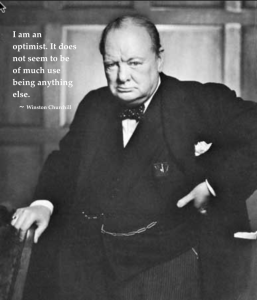
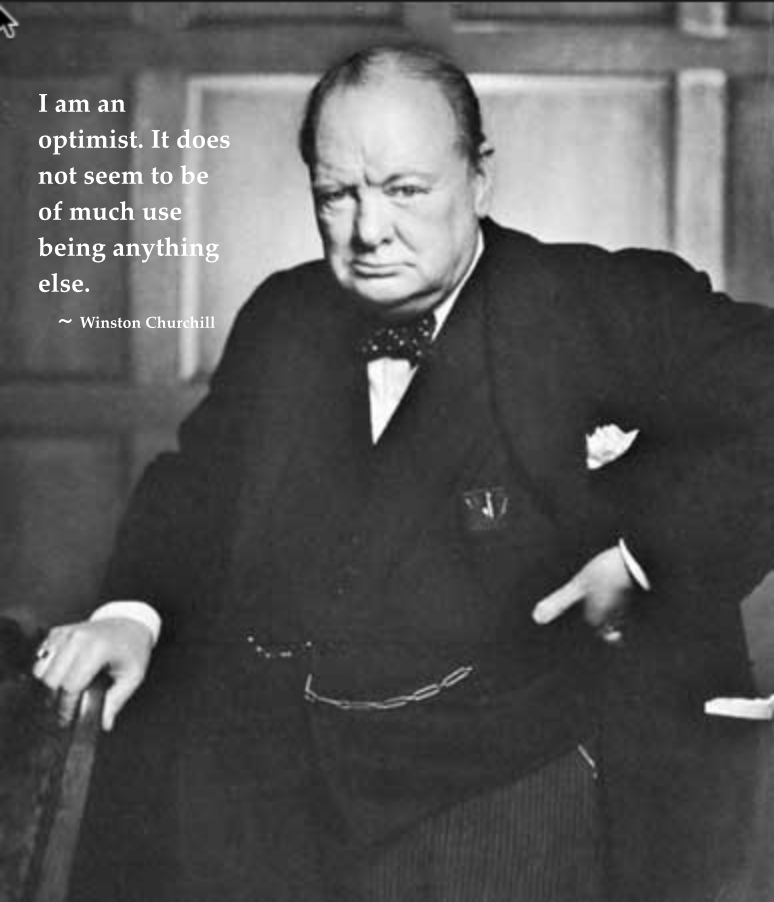
Churchill Image: I am an optimist2
At first, I figured it was too late to talk about surviving the economic storm we’re in … and then, I thought, hey, this isn’t over.

What does this recession really look like?

Maybe the sense of impending doom has dissipated but the reduced level of business activity and an increasing sense of frugality in a buyer-dominated market are going to be our unbidden passengers for quite a few more miles.
“Let us go into the storm … and through the storm,” said Winston Churchill as he prepared England to confront the Nazi regime in World War II.
As it applies to our current business climate, I thought this might be a touch of hyperbole, but then I recalled that Churchill’s odyssey raged for five years, not just the single year we’ve navigated since September 2008.
[pullquote]“Now this is not the end. It is not even the beginning of the end. But it is, perhaps, the end of the beginning.” ~ Winston Churchill[/pullquote]
Imagine Churchill, FDR and others slogging for five dreadful years through the greatest threat to civilization we have known.

How do we carry on the fight over a longer period?

So, how do we get through four more years of this business cycle, a time frame proclaimed by many before employment gets back to 6 percent and more customary growth trends resume?
Consider these few concepts inspired by the triumph and tragedy of those years: (more…)

Continue ReadingVol. 51 – Never Give Up! Never, Never, Never!