As we’ve all learned, most of life’s lessons don’t travel in a neat formation accompanied by bugles and cavalry. They arrive filthy and unkempt, prominent in the mess we’ve made around our foxhole. These lessons are typically the offspring of hubris, naivete and ignorance … or from overlooking the land mines hidden beneath our feet.
Every Tuesday, we’ll share valuable and practical leadership tips and tools to help you BE a better leader so you can BECOME a better leader. Remember … you won’t BECOME a better leader until you start BEING a better leader … implementing NOW the changes necessary to adopt the proven strategies of successful leaders.
Does your company have a Vision/Mission Statement that you clearly understand … and everyone knows who it belongs to?
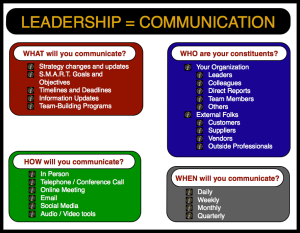
Last week, we talked about the proposition that Leadership = Communication and I shared a communication matrix with you to help you start on a Communication Action Plan.
There’s no doubt that communication stands tall in the pantheon of business leadership, and we all probably think we’re pretty good at it. We can walk, talk, dictate, speak and even string together a few intelligible sentences. We chat with our troops, talk to our customers and vendors, share information with colleagues and shareholders. We hold meetings, BBQ’s and off-sites to talk about what’s going on. We’re all pretty good at communication . . . or are we?
The inimitable Mr. Webster focuses on the transmission of thoughts and ideas, as if the means of communicating, or the act itself, constitutes “communication”. Yet, when you peruse a thesaurus for synonyms, you get words like, “communion”, “connection”, “conversation” and “interchange”, as well as “transmission” and “advisement”. When you think of “advisement” and “transmission”, it’s more about talking than conversing, while with “connection” and “conversation”, you expect a collaborative, two-way exchange.
President Reagan was known as the “Great Communicator” precisely because he could capture the essence of the point he wanted to make in clean, simple language that connected with people on an emotional level. His delivery was smooth and practiced and Americans always thought they knew where he stood. In President Reagan’s farewell address to the nation, he acknowledged the mantle of the “Great Communicator” but said “I never thought it was my style or the words I used that made a difference: it was the content. I wasn’t a great communicator but I communicated great things . . . . “ Take a look at Warren’ Buffett’s 2010 letter to Berkshire Hathaway shareholders as another example of straightforward communication.
In thinking about “communicating great things”, you’ve probably heard many times that your company should have a Vision and/or Mission statement.
Here are two examples of Mission statements from well-known companies.
There’s nary a clue about the identity of these companies, is there? These are not very good examples of communication because they are either too “Mom and apple pie”, or dance between pomposity and verbosity, as in the second example. They’re innocuous and impersonal, and while they may sound righteous, they stand for nothing.
Most Vision and Mission statements are generally derived in a conversation about the “purpose” of your company. Why are we here? What are we trying to accomplish? How will people remember us when we’re gone? Will they? It’s about you, digging deep to focus on why you’re coming to work each day and busting it from dawn until dusk.
Like Indiana Jones chasing the Holy Grail, some business consultants are obsessed with Vision and Mission Statements. While they can serve as cornerstones of the company’s “Strategery”, their value is in direct proportion to the breadth and depth of the strategic conversation about what’s really important and what differentiates their view of the world.
In simple terms, a Vision Statement seeks to “communicate” the core values and purpose of an organization, and looks to the future, to “what is possible” rather than “what is”. It’s more about inspiration than perspiration.
The Mission Statement says exactly what you do – now – and like a good “elevator speech”, can be recited in the time it takes you to get from the 1st to the 10th floor. It should use clear, muscular language to tell people succinctly “who you are” and “what you do”. It’s what the perspiration is all about.
These make a lot more sense, don’t they? And, it’s not too hard to see the mission of Harley-Davidson or Levi Strauss in these words. Contrarily, did you guess correctly about Hughes Supply and Albertson’s in the earlier two examples?
Conclusion? You can stop revising your Vision and Mission statements when you can post them on the walls throughout the company and be as proud of them tomorrow as you are today.
No one snickers when they read them; everyone in the company understands them, can recite them and embraces them as the embodiment of what they’re doing. Customers, vendors and shareholders will clearly understand what you do … why you’re here … and see the mission consistently throughout your organization.
That’s communication!
Be the first to comment!