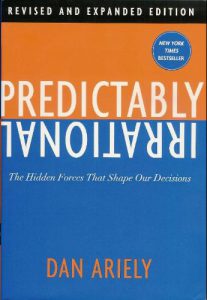
Dan Ariely, author of Predictably Irrational, is an insightful guy who recently performed some studies regarding cheating. (You’ll need to scroll down to the 3rd article.)
What he found suggests that some predisposition toward cheating may come from events that occur just prior the incident. He discusses, for example, one case where people were found more likely to cheat on a math test if they were a step removed from the cash payoff, say getting tokens to be redeemed later rather than cash. In one interesting variation of that test, there was no virtually no cheating after each of the participants was tested on his/her recall of the Ten Commandments.
In another case, subjects who wore “knock-offs” were twice as likely to cheat than those who were wearing the original product, suggesting some self-image aspects that are quite fascinating.
Patrick Lencioni has got it right in his guest column in Business Week recently: There’s no substitute for taking an active interest in the lives of your employees. The MBWO – “managment by walking around” theory has always been popular in these pages as a simple, no-cost tool to stay in touch with employees … not to check up on them but to engage them in spontaneous dialogue, encourage their excellence, find out what’s getting in the way of their success, champion their ideas and causes.
You can help them find job fulfillment and dramatically increase their engagement in the company’s performance. Read this article, take it to heart and begin practicing it NOW!
I mentioned here before about the regular Sunday NY Times feature called the Corner Office, which summarizes conversations with various CEO’s about leadership, lessons learned, interviewing techniques, etc. Here are 4 key lessons:
Read the full post »
The North Bay Business Journal, a publication of the New York Times, is a weekly business newspaper which covers the North Bay area of San Francisco – from the Golden Gate bridge north, including the Wine Country of Sonoma and Napa counties.
This page provides the Print-Friendly Version of the article, as published.
Any related materials or articles referenced in the column, or otherwise applicable, will also be referenced below:
The electronic version of the article, as published, may be found here.
**********************************************************************************
Article published -September 14, 2009

“Temperance and labor are the two best physicians of man; labor sharpens the appetite, and temperance prevents from indulging to excess.”
– Jean-Jaques Rosseau
You’ll recall that last time, we catalogued the perils of pride and envy in the pursuit of business success, but alas, we’ve barely dented the list of Seven Deadly Sins.
During this economic tumult, we’ve seen excesses like never before in our lifetimes … excessive credit card and mortgage debt, inflated housing prices, financial malfeasance, Ponzi schemes, egregious compensation plans and much more. It’s no surprise, then, that three of these seven misdeeds are offenses of excess in various incarnations.
Gluttony appears on the list and is defined as the “inordinate desire to consume more than you require,” which originated with concerns for wasting food in the midst of poverty. Thomas Aquinas, a medieval religious thinker, even identified six ways to commit gluttony, including consuming too much, too soon, too eagerly or too expressively – maybe the perfect expression of the runaway consumer spending that brought our economy to its knees.
“Qu’ils mangent de la brioche,” famously translated as “Let them eat cake,” is arguably attributed to Marie Antoinette on the eve of the French Revolution, hailing the ignominious end to another age of excess.
Read the full post »
There’s no better time to re-examine our assumptions about what works and what doesn’t. How many times have we seen the power of unconventional thinking (quit using the tired “out of the box” thinking metaphor) … and how frequently have our traditional beliefs been skewered as a result?
Here’s a story about a high school football coach in Arkansas that vividly reminds us that it’s valuable to challenge assumptions … it’s wise to see if metrics support those assumptions … and it’s prudent to try new things to see how they work. This coach has had tremendous success doing just the opposite of what we see every Saturday and Sunday during football season.
Take a fresh approach to old ideas that are holding you captive – jettison those that don’t hold up to close examination – and see if you can uncover some new ideas will jump-start your renewal.
Gretchen Morgenson, a NY Times columnist, reports that shareholders are speaking out more than ever as they seek to hold directors accountable. It’s a welcome trend, as we know that too many directors are really just cronies of the owners and don’t provide the unbiased, independent feedback that’s expected of them.
As you build your own Boards of Directors or Advisors in the middle market, make sure that your candidates will have time to pay attention and that you can depend upon them for direct and candid counsel. Otherwise, don’t bother. You can agree with yourself all by yourself!
Thomas Friedman’s Op-Ed in the Sunday NY Times entitled Real Men Tax Gas, makes sense in many ways, mostly in arguing that we have not proven to be very “tough” in making the difficult decisions. At the same time, Friedman presupposes that a gas tax would provide significant funding that the “government” could then deploy to reduce the deficit and fund health care.
Read the full post »
Whenever I find an article about innovative or alternative financing, it’s worth sharing. Creative financing has never been more needed as businesses seek to preserve and protect their franchise.
While these alternatives may not be applicable to your business, use this information to jumpstart your creative juices to consider different tools in the financing arsenal. There is no silver bullet so don’t hesitate to think about cobbling together more than one financing source or idea to get the result you need.
Forbes Magazine recently ran an intriguing article about eight different, million-dollar businesses they discovered, each with a special niche.
I love these articles because they highlight the different ways we can be successful and usually offer some unique insights from entrepreneurs who have an idea, however novel and offbeat, and with determination and grit, turn it into a winner.